It Was Never a Phase. The Science Behind the Bond That Doesn't Break.
Why the human-horse connection is one of the most neurologically significant relationships a person can form, and why it never fully lets go.

There is a particular kind of person who can drive past a field, spot a horse standing at the fence line, and feel something shift in their chest. They may not have ridden in five years. They may not have ridden in twenty. It does not matter. The feeling arrives anyway, quiet and certain, like a frequency their nervous system never stopped tuning to.
Most people who have felt this have also spent some portion of their life being told it was a phase. That the obsession with horses was a childhood thing, a girl thing, a thing they would eventually outgrow. And yet here they are, decades later, still slowing the car down.
This is not sentimentality. This is not nostalgia dressed up as identity. What is happening in that moment, in that chest, in that nervous system, is the result of one of the most neurologically significant inter-species bonds a human being can form. And the science behind it is more extraordinary than most people realize.
The Subconscious Never Forgot
To understand why the horse bond persists across decades, it helps to understand how the brain stores experience in the first place.
Neuroscience research consistently shows that approximately 95% of daily decisions, emotional responses, and behavioral patterns are driven by the subconscious mind rather than conscious thought. The subconscious does not reason or evaluate. It records. It stores emotionally charged experiences as templates, and it uses those templates to shape how a person perceives and responds to the world long after the original experience has passed.
This is not a metaphor. It is a measurable neurological process. The brain’s limbic system, which governs emotion and memory, encodes experiences differently depending on their emotional intensity and their association with core psychological needs. Experiences that activate belonging, safety, trust, and unconditional acceptance are not stored as ordinary memories. They are stored as foundational reference points, ones the nervous system returns to again and again as a baseline for what safety and connection feel like.
For a significant portion of the equestrian community, the barn was one of the first places that reliably produced that state. And the brain, being the extraordinarily efficient pattern-recognition machine that it is, never stopped associating horses with that feeling.
Maslow, Belonging, and the Barn
To understand the depth of this, it is worth grounding it in one of the most foundational frameworks in human psychology: Abraham Maslow’s hierarchy of needs.
Maslow proposed that human motivation is organized into a hierarchy of five core need levels. Physiological needs sit at the base. Safety needs come next. Above those sits the third tier: love and belongingness, the deep human need for connection, acceptance, friendship, and the feeling of mattering to something beyond oneself.
Maslow was clear that this need is not optional. It is not a preference or a personality trait. It is a fundamental driver of human behavior, one the brain pursues with the same urgency it applies to physical safety. When love and belonging needs go unmet, the psychological consequences are significant: feelings of worthlessness, hopelessness, and a chronic sense of being unseen.
What makes the horse relationship so neurologically powerful is that it meets this need in a way that is almost entirely unique. The horse does not evaluate. It does not perform. It does not have a social agenda or a hidden motive. It responds to presence, to emotional state, to the quality of attention a person brings into the space. For a child or adolescent navigating the complexity of human social hierarchies, the barn offered something rare: a relationship where acceptance was not conditional on performance, appearance, or social standing.
The brain encodes that kind of experience at a cellular level. It does not file it under childhood hobbies. It files it under the category of experiences that made life feel safe and meaningful. And it spends the rest of a person’s life looking for ways to return to it.
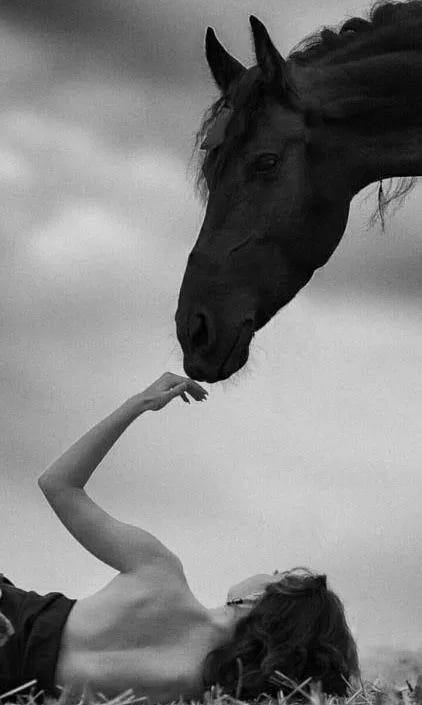
The Neurobiological Improbability of This Bond
Before going further into the science of what happens between humans and horses, it is worth pausing to acknowledge how improbable this bond is from a purely biological standpoint.
The human brain evolved, in significant part, for predation. Forward-facing eyes provide depth perception optimized for tracking prey. The prefrontal cortex, the most developed region of the human brain, is built for strategy, planning, and the kind of executive function that makes sustained pursuit possible. Humans are, by evolutionary design, predators.
The horse brain evolved for exactly the opposite purpose: survival from predators. Horses have eyes set on either side of their head, providing a panoramic field of view of approximately 340 degrees. Their pupils are horizontal, optimized for scanning the horizon for threat. Their nervous system has a direct, high-speed pathway from threat perception to the motor cortex, allowing near-instantaneous evasion. The horse is, by evolutionary design, prey.
By every biological measure, these two species should not be able to form a trusting bond. The horse’s nervous system should register the human as a threat. The human’s nervous system should register the horse as a resource. And yet, across thousands of years of co-evolution, something entirely different happened.
As Janet Jones writes in her landmark essay for Aeon, the horse and human developed a form of brain-to-brain communication that operates through body language alone, with no linguistic or mechanical mediation required. The horse’s extraordinary touch sensitivity, its natural reliance on body language as a primary communication medium, and its remarkable capacity for learning created the conditions for a feedback loop between two fundamentally different nervous systems. A feedback loop that, with time and trust, becomes something researchers are only beginning to fully understand.
Brain Wave Synchronization: The EEG Evidence
One of the most compelling bodies of research on the human-horse bond comes from electroencephalography studies that have measured brain activity in both species simultaneously during interaction.
EEG research allows scientists to measure the proportion of different brain wave frequencies in real time: delta waves associated with deep sleep, theta waves associated with low arousal and emotional processing, alpha waves associated with active wakefulness, beta waves associated with moderate arousal, and gamma waves associated with heightened attention, emotional arousal, and sensory integration.
Studies conducted by researchers including Cousillas, Hausberger, and d’Ingeo have used telemetric EEG devices developed specifically for horses to measure these wave patterns during human-horse interaction. The findings are striking. As the interaction between horse and human becomes more intimate, moving from standing nearby to physical contact to active engagement, the brain wave profiles of both species begin to converge. The horse’s neural patterns begin to mirror elements of the human’s, and vice versa.
Research published in 2009 by Crews at Arizona State University found that the brain maps of horse and human became progressively more synchronized as the interaction deepened. Passing from no contact, to petting, to grooming, to riding, each stage produced measurably greater neural alignment between the two subjects.
This is not a metaphor for connection. This is two nervous systems, one human and one equine, entering a shared neurological state through sustained, trust-based interaction.
The Emotional Memory of the Horse
Perhaps the most personally significant finding for anyone who has ever loved a horse is this: the horse remembers them too.
Research published in Current Biology in 2018 by Proops, Grounds, Smith, and McComb demonstrated that horses form long-lasting emotional memories of specific human individuals based on the facial expressions those individuals have previously displayed. In the study, horses were shown photographs of either a happy or an angry human face. Hours later, when those same humans appeared in person with neutral expressions, the horses that had previously seen the angry face showed a left-gaze bias, indicating right-hemisphere processing associated with threat detection and heightened vigilance.
The horse had not just recognized the person. It had retained the emotional valence of the previous interaction and applied it to the new encounter. It was, in effect, carrying a relationship history.
This finding has profound implications for understanding why the human-horse bond feels so different from other animal relationships. The horse is not simply responding to the person in front of it. It is responding to the accumulated emotional history of every interaction that came before. A horse that has been handled with kindness, patience, and consistency is not just calm. It is calm because it has built an internal model of that specific human as safe, trustworthy, and worth approaching.
That model, once built, persists. And for the humans who built it, the knowledge that they were known and remembered by an animal that had no reason to trust them, and every biological reason not to, is one of the most quietly profound experiences a person can have.
The Emotional Transfer Hypothesis
In 2019, researchers Scopa, Contalbrigo, Greco, Lanata, Scilingo, and Baragli published a landmark review in the journal Animals proposing what they called the emotional transfer hypothesis. The hypothesis states that during human-horse interaction, the two subjects undergo a mutual coordination of emotional states, a coupling process in which their physiological activities, including heart rate, heart rate variability, and brain activity, begin to converge.
The researchers proposed that this emotional transfer is the proximate mechanism behind the documented therapeutic benefits of equine-assisted interventions. It is not simply that horses are calming to be around. It is that horses and humans, when in sustained positive interaction, begin to function as a single coupled system, each influencing the other’s physiological and emotional state in real time.
Supporting this, a study by Lanata and colleagues found that human chemosignals, the body odors produced under specific emotional conditions, triggered measurable responses in the autonomic nervous system of horses. Horses exposed to human fear odors showed different cardiac responses than those exposed to human happiness odors. They were not just reading body language or facial expressions. They were detecting human emotional states through olfactory channels, through scent alone.
The implications of this are significant. Every time a person entered a barn carrying anxiety, grief, excitement, or joy, the horse already knew. Before a word was spoken, before a hand was extended, the horse had already begun to process and respond to the emotional state of the person walking toward it. The relationship was never just about riding. It was a continuous, bidirectional exchange of emotional information between two living systems.
The Oxytocin System and Why the Bond Feels Like Safety
The neurochemical architecture of the human-horse bond helps explain why it feels the way it does, and why it leaves such a lasting imprint.
Research reviewed by Beetz, Uvnas-Moberg, Julius, and Kortschal in Frontiers in Psychology (2012) identified the oxytocinergic system as the primary neurochemical mechanism underlying the positive effects of human-animal interaction. Oxytocin, often called the bonding hormone, is released during positive social contact, including touch, eye contact, and sustained proximity with a trusted other. Its effects are wide-ranging and profound: it reduces cortisol, lowers blood pressure, decreases heart rate, suppresses the amygdala’s fear response, increases trust, and promotes social engagement.
In the context of the horse relationship, this means that the physical act of being with a horse, grooming it, riding it, standing quietly beside it, is not just emotionally pleasant. It is neurochemically regulatory. The nervous system is being actively calmed and reorganized through the interaction.
For children and adolescents, whose stress response systems are still developing, this matters enormously. Neuroscience research confirms that early experiences of safety and emotional attunement shape the architecture of the brain’s stress response for life. The hippocampus, which governs memory and emotional regulation, is particularly sensitive to early relational experiences. Environments that consistently produce oxytocin release and cortisol reduction during development do not just feel good. They shape the baseline from which the nervous system operates for decades.
This is why the barn was not just a place. For many people, it was the environment in which their nervous system learned what regulated, safe, and connected felt like. And the brain, having learned that, spends the rest of a person’s life recognizing and seeking the conditions that produced it.
The HeartMath Research: A Field Between Them
One of the most remarkable findings in the science of human-horse connection comes from the HeartMath Institute, whose research on heart coherence and inter-species connection has produced data that challenges conventional assumptions about the boundaries of individual nervous systems.
The HeartMath Institute’s research demonstrates that the human heart generates an electromagnetic field that extends several feet beyond the body and is detectable by sensitive instruments. What is less widely known is that the horse’s heart generates an electromagnetic field that is approximately five times stronger than the human heart’s field.
HeartMath researchers have found that when a person enters a state of heart coherence, a regulated, positive emotional state characterized by smooth, ordered heart rate variability, horses in proximity respond with measurable behavioral and physiological calm. Conversely, when a person is in a state of emotional dysregulation, horses mirror that state, becoming more alert, more reactive, and more difficult to settle.
This is not the horse reading body language in the conventional sense. This is two electromagnetic fields interacting. Two biological systems influencing each other at a level that precedes conscious awareness or deliberate communication.
The HeartMath research reframes the barn in a way that is both scientifically grounded and quietly extraordinary. The horse was not just an animal a person learned to ride. It was a living biofeedback system, one that responded to the quality of a person’s inner state with a sensitivity no human relationship could match. In the presence of a horse, there was nowhere to hide and no reason to. The horse already knew. And it stayed anyway.
The Esteem Need and the Horse That Didn’t Judge
Maslow’s fourth tier of the hierarchy of needs is esteem: the need for self-respect, competence, achievement, and recognition from others. Healthy esteem, Maslow argued, must be grounded in genuine achievement rather than false praise. It requires a stable, accurate evaluation of one’s own strengths and limitations.
The horse relationship is one of the few relational contexts that provides this kind of honest feedback without cruelty. A horse does not pretend. It does not offer false encouragement or withhold recognition out of social politics. When a rider improves, the horse responds differently. When a rider is tense, the horse reflects that tension back. The feedback is immediate, honest, and entirely free of the social complexity that makes human feedback so difficult to trust.
For young people in particular, this quality of honest, non-judgmental feedback is extraordinarily rare. The school environment, the peer environment, the family environment, all of these are saturated with social performance and evaluation. The barn offered something different: a relationship in which competence was measured not by grades or social approval but by the quality of connection with another living being.
Research on self-determination theory, developed by Deci and Ryan, identifies three fundamental psychological needs: autonomy, competence, and relatedness. The horse relationship, at its best, meets all three simultaneously. The rider develops genuine competence through honest feedback. They experience autonomy in their ability to direct and influence a powerful animal. And they experience deep relatedness through a bond that is built on trust rather than obligation.
This combination is rare in any relational context. In the context of a child’s development, it is formative in ways that extend far beyond the barn.
The Welfare State of the Horse Matters Too
One of the most significant findings in recent equine research is that the horse’s experience of the relationship is not passive. The horse’s welfare state, its chronic emotional and physiological condition, directly shapes how it perceives and responds to human emotional cues.
Research published in Animals (2025) by d’Ingeo, Siniscalchi, Quaranta, Cousillas, and Hausberger studied two populations of horses with dramatically different living and working conditions. Horses in naturalistic conditions, living in stable social groups with limited, positive human contact, showed calm, differentiated responses to human emotional voices. They responded most strongly to anger, showed mild interest in positive voices, and demonstrated low overall reactivity.
Horses in restricted conditions, kept in individual stalls with frequent contact with many different riders, showed high behavioral and cardiac reactivity to all negative human voices. Their brain activity showed bilateral theta wave increases in response to fear and anger, indicating an alarm state. They had, in effect, developed a cognitive bias toward negative emotional information, a state the researchers directly linked to compromised welfare.
This finding matters for the human side of the bond as well. The quality of the relationship a person builds with a horse is not just a function of their own emotional state. It is a co-created experience, shaped by the history, welfare, and relational context of the horse itself. The horses that left the deepest impressions on people were, in most cases, horses that were well cared for, emotionally stable, and capable of genuine positive engagement. The bond that forms in those conditions is qualitatively different from anything that can be produced through force or compliance.
Why They Come Back
All of this science converges on a single answer to the question that anyone who has ever loved a horse has asked themselves at some point: why does this feeling never fully go away?
The answer is that the human-horse bond, when formed in conditions of genuine trust and positive interaction, does not just create a pleasant memory. It creates a neurological template. A reference point encoded in the subconscious mind for what safety, belonging, honest feedback, and unconditional presence feel like. A template the nervous system spends the rest of a person’s life trying to find its way back to.
The pull they feel when they pass a field is not nostalgia. It is recognition. The nervous system identifying the conditions that once produced something it has been looking for ever since.
Maslow wrote that human beings are always becoming, always moving toward the conditions that allow them to grow, connect, and feel fully alive. The horse, for the people who have known this bond, is one of the clearest paths back to that state that exists.
It was never a phase.
It was never going to be.
The Community That Was Built Around It
The equestrian community is not a demographic. It is not a market segment defined by income bracket or geographic location. It is a group of people who share a neurological experience, one that shaped them at a foundational level and never fully released its hold.
The creators, the riders, the brands, the people who never stopped and the people who are finding their way back, they are not connected by a hobby. They are connected by a shared imprint. A shared understanding of what it feels like to be in relationship with something that demands nothing but honesty and gives back something that no human relationship can fully replicate.
That is not a niche.
That is one of the most emotionally engaged, deeply loyal, and chronically underestimated communities in the world.
The science just gave it a name.
Sources referenced: HeartMath Institute research on human-horse heart coherence | d'Ingeo et al., Animals (2025) | Scopa et al., Animals (2019) | Proops, Grounds, Smith and McComb, Current Biology (2018) | Beetz et al., Frontiers in Psychology (2012) | Janet Jones, Aeon (2022) | Maslow's Hierarchy of Needs, Simply Psychology | Deci and Ryan, Self-Determination Theory | Neuroscience research on subconscious decision-making
Wow thank you for this! Very profound. Amazing how science can start to explain our shared experiences. I'm glad I returned to the barn recently after a 15 year break!
Explains a lot about this “horse crazy” girl🙂